
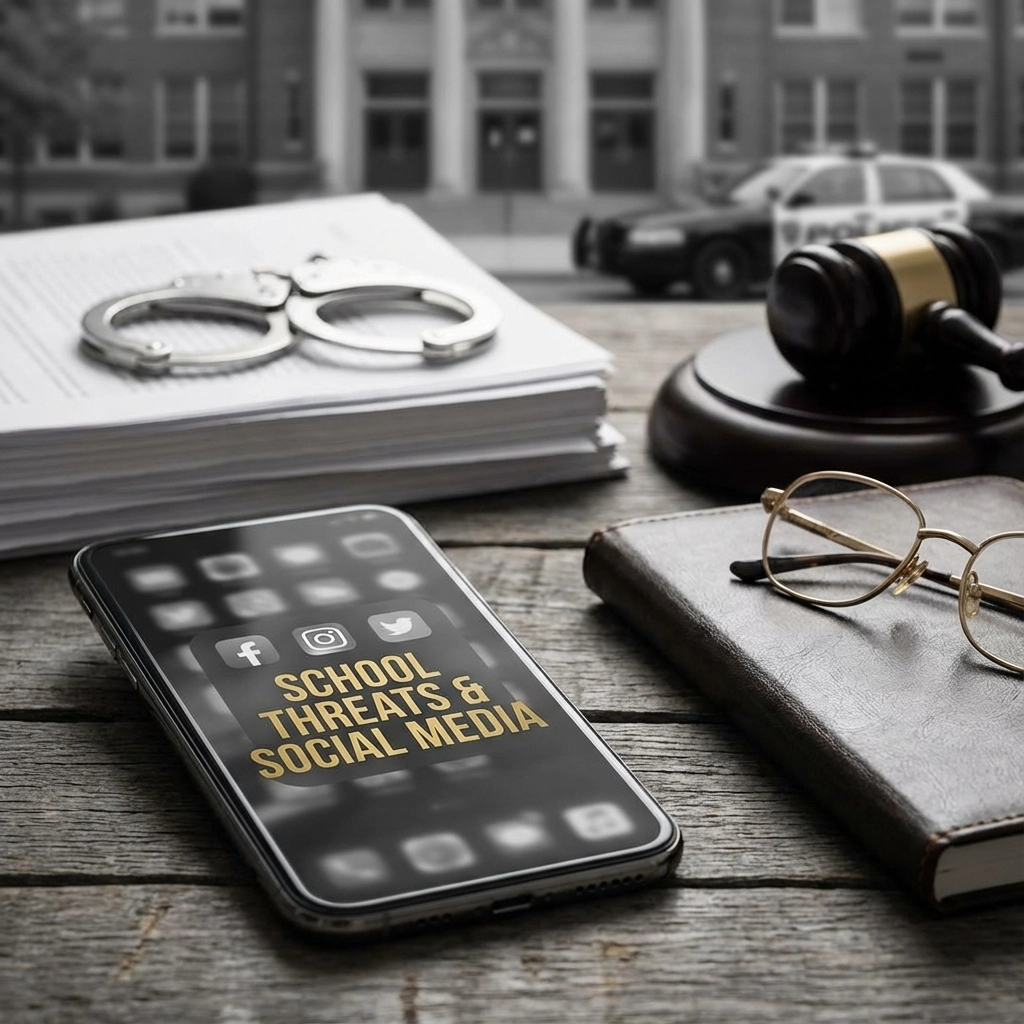
Your teenager sends what they think is a funny meme about "bombing" Monday's math test. Within hours, police are at your door with handcuffs.
That's not an exaggeration. That's the reality facing Virginia families right now as schools, law enforcement, and prosecutors take an increasingly aggressive stance toward any social media post that could be interpreted as a threat.
The line between teenage humor and felony charges has never been thinner: and the consequences have never been more severe.
When a Meme Becomes a Criminal Case
Here's what happened to 16-year-old Marcus from Henrico County. After a particularly stressful week of exams, he posted a TikTok video with the caption: "About to blow up this school with my test scores 💣📚." The emoji seemed harmless. The context seemed obvious.
The school administration didn't see it that way.
Within 24 hours, Marcus was suspended, arrested, and charged with making threats against a school: a Class 6 felony in Virginia that carries up to five years in prison and a permanent criminal record.
His parents thought it would blow over. They thought common sense would prevail.
They were wrong.
The case went to court. The prosecution argued that in today's climate, any reference to violence at school must be taken seriously, regardless of intent. The defense argued it was clearly hyperbole about academic performance.
Marcus spent six months fighting felony charges for what his family still considers a harmless joke about getting good grades.

Virginia's Zero-Tolerance Reality: The Laws Working Against Your Teen
Virginia Code § 18.2-60 makes it a crime to communicate threats to "commit acts of violence" against any person or group of persons. When that threat involves a school, the penalties become even more severe under Virginia Code § 22.1-279.3.
Here's what you need to understand: The law doesn't require proof that your teenager actually intended to carry out violence. It doesn't require proof that anyone felt genuinely threatened. It only requires that the words could reasonably be interpreted as a threat.
That means your teenager's sarcastic comment about "destroying" a pop quiz could land them in juvenile detention.
The prosecution doesn't have to prove your child is dangerous. They only have to prove the words were communicated and could be seen as threatening.
And they're winning these cases.
The Social Media Amplification Effect
Social media transforms every teenage comment into permanent evidence that can be screenshot, shared, and analyzed out of context. What might have been forgotten lunchroom banter twenty years ago now becomes a prosecutable offense with digital fingerprints.
Virginia courts have ruled that social media posts carry the same legal weight as face-to-face communications. Your teenager's Snapchat story has the same potential for criminal charges as standing up in class and making the same statement.
But there's a crucial difference: Social media posts lack tone, context, and the immediate clarification that comes with in-person communication.
When your teenager posts "This homework is going to kill me," the algorithm doesn't understand hyperbole. The school administration seeing that screenshot doesn't hear the exasperated sigh or see the eye-roll that would immediately signal frustration rather than violence.
The result? More investigations. More arrests. More families destroyed over misunderstood teenage communication.

The Investigation Process: When Your Doorbell Becomes Your Nightmare
Here's how these cases typically unfold: and why every day matters in protecting your teenager's future.
Day 1: A school administrator, student, or parent reports the social media post as a potential threat.
Day 2-3: School security reviews the post and forwards it to local law enforcement. Your teenager may be called to the principal's office for questioning: often without you being notified.
Day 4-7: Police begin their investigation, which may include searching your teenager's social media accounts, interviewing classmates, and building a criminal case.
Day 8-14: If police determine they have enough evidence, they'll seek an arrest warrant. This is often the first time parents learn their teenager is under investigation.
The critical window you're missing: Those first seven days when your teenager might be questioned without legal representation, when evidence is being gathered, and when the trajectory of their entire future is being determined.
By the time most parents realize their family is in legal jeopardy, the damage is already done.
The Juvenile Justice Steamroller: Why "Kids Being Kids" Isn't a Defense
Virginia's juvenile justice system processes these threat cases with assembly-line efficiency. Here's the reality your family faces once charges are filed:
Intake and Detention: Your teenager could be held in juvenile detention while awaiting their first court appearance, sometimes for days or weeks.
Court Hearings: Unlike adult court, juvenile proceedings move quickly. You may have less than two weeks to prepare a defense for charges that could follow your child into adulthood.
Sentencing Options: Even if your teenager avoids detention, they're facing probation, community service, mandatory counseling, and a juvenile record that colleges and employers can access.
The Long-term Impact: Many Virginia colleges and universities require disclosure of any criminal charges, even those handled in juvenile court. Scholarship opportunities disappear. Military service becomes complicated. Future employment gets exponentially more difficult.
The prosecutor doesn't care that your teenager was joking. The judge doesn't care that they've never been in trouble before. The system cares about conviction rates and sending a message.
Your teenager becomes the message.

Real Consequences for Virtual Words: What Families Are Losing
The Hendricks family from Virginia Beach learned this the hard way when their 17-year-old daughter posted a frustrated comment about her chemistry teacher: "Someone should just blow up the whole science wing and put us all out of our misery."
The result:
- Felony charges that took eight months to resolve
- $12,000 in legal fees
- Loss of her early admission to Virginia Tech
- Mandatory anger management counseling
- Two years of probation
- A permanent mark on her record that she'll explain for the rest of her life
The family thought hiring any attorney would be enough. They didn't realize that juvenile law requires specialized expertise in both criminal defense and educational law.
They didn't understand the stakes until it was almost too late.
The Defense That Could Save Your Teenager's Future
Defending against school threat charges requires understanding both the legal landscape and the social media environment where these cases originate. The prosecution will focus on the words. A skilled defense focuses on the context.
Constitutional protections still apply to teenage speech, even on social media. The First Amendment doesn't disappear when your child creates a TikTok account. But asserting these protections requires legal expertise that most families don't possess.
Intent analysis becomes crucial in these cases. Did your teenager actually intend to communicate a threat, or were they using common teenage hyperbole that got misinterpreted? The difference determines whether they face felony charges or walk away with their future intact.
Digital forensics can often prove that posts were taken out of context, manipulated, or shared beyond their intended audience. But this evidence disappears quickly if it's not preserved properly.
School policy violations vs. criminal charges represent two completely different legal universes. Many families accept school suspension thinking that's the end of the matter, only to discover criminal charges are pending.

Protecting Your Teenager Before It's Too Late
The conversation you need to have today: Your teenager needs to understand that social media posts about school, teachers, or classmates can be interpreted as criminal threats, regardless of intent.
Words that trigger investigations:
- Any reference to "bombing," "destroying," or "blowing up" anything school-related
- Comments about harming specific teachers or administrators
- Posts about bringing weapons to school, even as obvious jokes
- References to school shootings, even in the context of video games or movies
- Anything that could be screenshot and misinterpreted by someone who doesn't know your teenager personally
The reality check: Every post your teenager makes is permanent, searchable, and could be used as evidence in a criminal case. The audience isn't just their friends: it's potentially law enforcement, prosecutors, and judges who don't know your child's character or sense of humor.
When the Investigation Begins: Your First Call Should Be to Legal Counsel
If your teenager is being investigated for social media threats, every decision you make in the next 48 hours determines the outcome of their case.
Don't let your child speak to school administrators without legal representation. Don't assume the situation will resolve itself. Don't trust that "telling the truth" will make the charges disappear.
The system is designed to secure convictions, not to understand teenage humor.
At Alex Taylor Law, we've seen how quickly these cases escalate and how devastating the consequences can be for unprepared families. We understand both the legal framework and the social media landscape that creates these situations.
Your teenager's future is too important to leave to chance. The stakes are too high to hope for understanding from a system that treats teenage posts like criminal manifestos.
Contact us immediately if your family is facing these charges. We'll fight to protect your teenager's future before it's too late.
Because when it comes to your child's future, you need a soldier in a suit.
